

 Suomi
Suomi Svenska
 Dansk
Dansk Deutsch
 Polski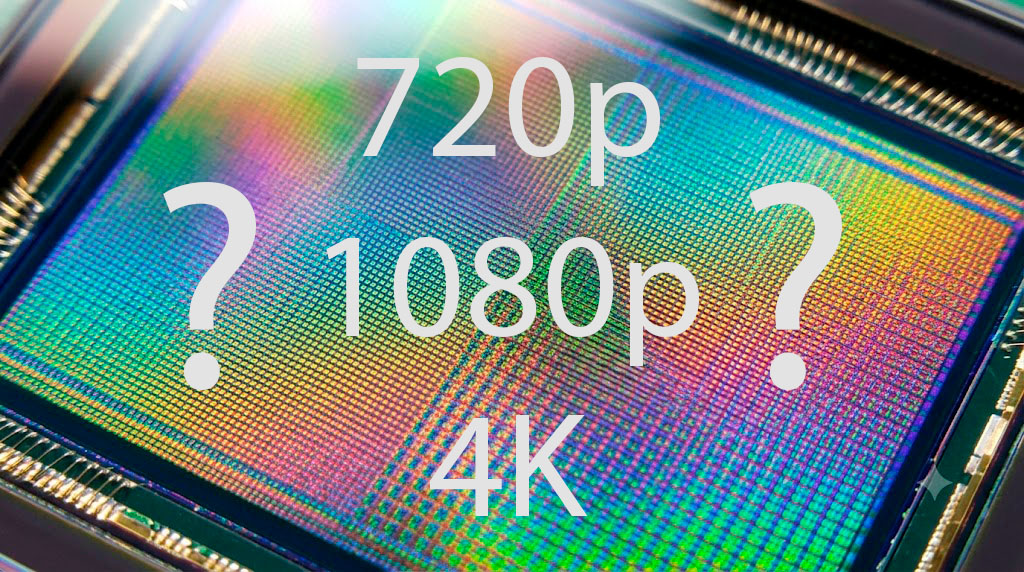
More megapixels do not always mean a better picture
With cameras, higher resolution is often synonymous with better image quality. Smartphones, televisions and computer screens have taught us that 4K is the standard video resolution, and that in photography too, more megapixels mean a better image. As a result, customers often want a device with the highest possible resolution, so that’s the first piece of information they look for in the technical specifications.
In the world of endoscopy, physics and optics impose limitations, which is why focusing solely on resolution can be misleading. We will now explain why a high megapixel count is often neither necessary nor even a technically sensible solution in an endoscope.
A high pixel count results in smaller pixels
The most important feature of an endoscope is its ability to fit into narrow tubes and crevices, often only a few millimetres wide. This means that the sensor (image sensor) at the tip of the camera must be extremely small.
If, for example, you want to fit the 8.3 million pixels required for 4K resolution onto this tiny sensor, the individual pixels must be made very precise and incredibly dense. This is where physics comes into play. When the size of the sensor remains the same but the number of pixels is increased, the physical size of each individual pixel decreases. A small pixel is like a small bucket in the rain: it can collect far fewer photons (light) in the same amount of time than a large pixel.
Because a small pixel receives less light, the electrical signal it produces must be amplified (by increasing the ISO setting). Amplifying the signal also amplifies background noise, which appears in the image as digital noise and blurriness, particularly when shooting in low light.
The end result is a 4K-resolution image on paper that may be less sharp and noisier than an image taken with a high-quality, lower-resolution sensor. This is because larger pixels are able to utilise low light levels much more effectively.

Image showing the same photo taken in low light (left) and bright light (right). With a low light source, the image becomes noisy and loses detail.
Optical resolution
Even if we were to succeed in creating an extremely high-density sensor, the next limitation would be the endoscope’s optics. When light passes through a lens aperture of limited size, it bends. This phenomenon is known as diffraction.
Diffraction imposes a fundamental physical resolution limit on the optics: it determines how small details the lens is capable of resolving. In small optical systems, this limitation is particularly pronounced, as the small aperture and miniature optics make it difficult to achieve high resolution.
If the pixel density of the sensor exceeds the lens’s actual resolving power, a higher megapixel count no longer results in a corresponding increase in detail. In such cases, the sensor essentially records the image formed by the optics in greater detail, rather than capturing new details of the subject.
In practice, image quality is determined by the entire imaging chain: the combined effect of the optics, the sensor, the lighting and signal processing. A very high-resolution sensor alone does not guarantee high resolution if the optics are unable to transmit a sufficiently detailed image.
Usability challenges
Processing 4K video requires enormous computing power. When this processing takes place at the tip of the endoscope, it generates a significant amount of heat.
As it is not possible to fit fans or large heat sinks to the tip of the endoscope, the tip heats up rapidly. The thermal load can limit performance and require effective thermal management, particularly in a small camera tip.
Furthermore, the increased data volume places greater demands on the design of the cable and electronics, which can affect size, rigidity and cost. This inevitably makes the cable:
- Thicker
- Stiffer
- More difficult to manoeuvre
Consequently, the device loses precisely those characteristics that were the reason for purchasing the endoscope in the first place.
What should you look for instead of resolution?
When assessing an endoscope’s performance, don’t be blinded by megapixels alone. Instead, when making a purchase, you should first ensure that the camera can see exactly where you want it to. In other words, manoeuvrability and cable dimensions are the top priorities. Once you’ve confirmed that the cable physically meets the requirements, you can focus on other aspects, such as the light source or resolution. This topic is also covered in our endoscope buyer’s guide.